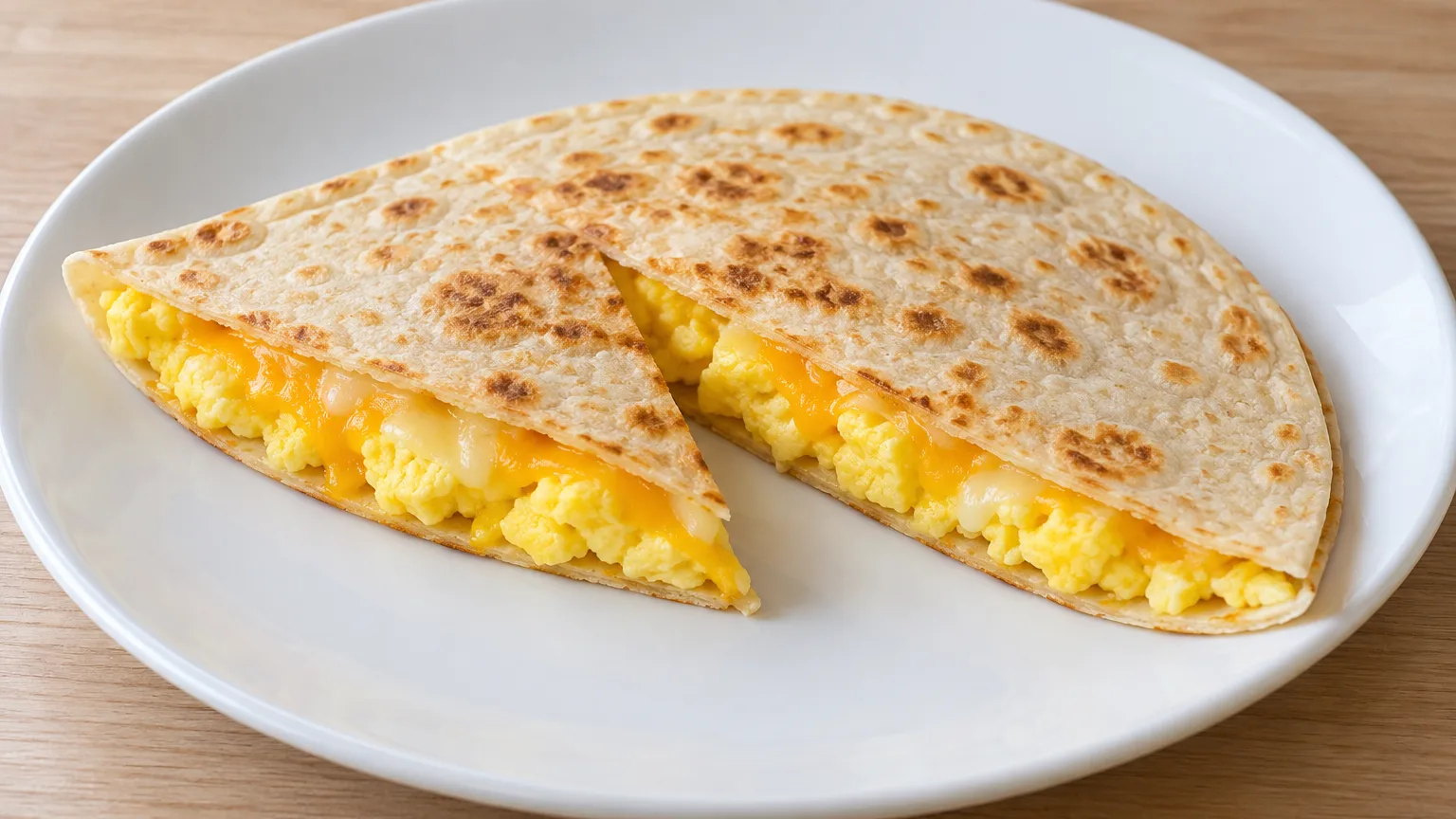

On a rushed morning, an air fryer helps most when it has one small task: crisp a wrap, bake an egg in a suitable cup or reheat a prepared portion. Choose that task before switching it on. A loose egg poured into the basket and a chilled sandwich are different jobs with different safety checks.
Crisp a wrap around a cooked filling
Fold a tortilla around a fully cooked egg portion and a small amount of cheese. Put it seam-side down in the basket, leave room for airflow, and use a suitable setting from your model's manual until the wrap is crisp and the center is hot. If the egg was cooked earlier and refrigerated, the wrap is a leftover: check its storage date and reheat the center to 165°F/74°C with a food thermometer. FoodSafety.gov gives that temperature for leftovers. Add avocado or raw greens after heating; they do not need to dry in the basket.
Make the tortilla small enough to sit flat. If it opens or a loose topping blows toward the heater, stop, let the unit cool as required and choose a safer assembly. Do not add parchment to hold it down unless your manual permits parchment and its placement. Philips advises against baking paper in its Airfryers and warns that loose paper can reach the heating element; check the instructions for your own model.
For a wrap assembled the night before, keep the cooked filling refrigerated and date it. On the morning, check whether the tortilla is packed so tightly that the center will remain cold while the outside browns. A shorter, thicker wrap may need a different warming method. Do not reuse a plate that held raw egg for the finished breakfast.
Bake one egg in a supported dish
Check your model's manual for a fitting oven-safe dish or silicone cup that leaves space around it. Philips lists ovenproof molds for its Airfryer, but that is not approval for every accessory in every model. Lightly oil the dish, add one beaten egg and a spoonful of already cooked vegetables, and place the dish in the basket. Set the appliance according to its manual for a small baked egg dish, then check the center with a food thermometer. An egg dish without meat or poultry needs 160°F/71°C, according to FoodSafety.gov. Browning on top does not establish that the center is cooked.
Use a mitt to lift the hot dish, and let the food settle before eating. If you add meat or poultry, use the safe temperature for that ingredient, not the egg-only benchmark. A deeper cup takes a different time from a shallow dish, so an unexplained universal timer would be misleading.
Try a small single-egg dish first. A container that is too wide makes a thin egg layer that can dry quickly; one that is too deep makes the center slower to set. Keep enough space around the dish for air to circulate and use only accessories the appliance allows. Record the dish size and setting if it works so you can repeat the result.
Warm a purchased or prepared breakfast carefully
For a frozen commercial sandwich, read whether it is fully cooked and whether its label permits an air fryer. Follow the product and appliance instructions; do not assume every frozen breakfast food can go straight from freezer to basket. If it is a homemade, previously cooked sandwich, verify its date and storage history first. Reheat the center to 165°F/74°C and add delicate toppings afterwards. If the outside browns while the center is cold, a microwave stage or another label-approved method may be better than more air-fryer heat.
Keep the basket clean for the next batch and let it cool before washing, as the manual directs. One breakfast that works on your model is more useful than a long list of timings copied from someone else's. The two-format breakfast prep guide covers what to prepare in advance; this page covers the air-fryer step.
On a genuinely rushed morning, choose a cold breakfast if heating and checking the center will take too long. An air fryer adds a useful texture step only when you have time to use it safely. The next trial can change one variable, such as dish depth, filling amount or basket load, without turning a successful small breakfast into an untested large batch.